MP16 | Miyazaki and CGI

Princess Mononoke (1997) release poster.

Hayao Miyazaki is globally lauded as a master director of the Japanese animated feature. His and the late Isao Takahata’s animation studio Ghibli is well known for its track record of making beautiful traditionally animated films ever since Castle in the Sky in 1986. (It should be said, too, that Japanese anime generally has retained its stylistic preference for 2D animation rather than CGI, unlike US feature animation which has generally turned 3D.)

However, Miyazaki’s more recent work that marked his breakout on an international level show a turn to digital techniques in order to fully achieve his films’ artistic visions. Starting with Princess Mononoke (1998), Miyazaki began to integrate computer graphics (CG) into his traditional pipeline, and his subsequent films Spirited Away (2001) and Howl’s Moving Castle (2004) included progressively more CG. Miyazaki’s techniques for these films is based around the philosophy of “CG that doesn’t look CG”. Still using cel animation and hand-painted backgrounds as starting points, 3D elements are included in order to better support three-dimensionality and visual effects that are not doable in traditional cel animation.

For the CG animation in Mononoke, the majority of which was still traditional cel animation, Studio Ghibli worked with Microsoft to develop Toon Shader, a software to make 3DCG made in Softimage look like hand-painted cel images. This was one of the first forays (if not the definite ‘first’) into creating crisp ‘cel’ shading on 3D objects, which is now commonly used in anime and games to evoke a 2D aesthetic.

The cel shading 3DCG method was important for the creation the demon sequence in the beginning of the film, where the tendrils were very difficult to animate individually. Fig. 1 shows the breakdown of one of the shots: the first two images show the tendrils’ wireframe and the resulting 3D object generated with Softimage, the third image is the 3D put through Toon Shader for a cel-shaded effect, and the fourth image shows the tendrils composited on to the hand-drawn character cel. Other uses for 3D simulation include water, which features prominently in Spirited Away.

Fig. 2
.

Generation of particles was another important 3D technique. In Fig. 2, the Nightwalker’s main body animation was done on cels, but the bioluminescent dots are generated in 3D and controlled by input variables. The same principles of particle generation were applied to generation of smoke and steam.

Background animation was another issue that was aptly addressed by CG. Fig. 3 shows a shot from Miyazaki’s earlier work Porco Rosso (1992) in which the camera tracks the moving airplane over a long distance. The background hills are entirely animated on cels, while the sky and clouds are a BG painting.

Fig. 3

For a similar moving-over-a-hill shot in Mononoke (Fig. 4), 3D mapping was used to ‘move’ an otherwise hand-painted background in physical 3D space. The top image in Fig. 4 shows the 3D plane, and the 2nd image shows the background painting mapped onto the plane. This would allow for better immersion, as seen in the finished animation (Fig. 5); it gives the illusion of the camera moving through space, as the hill is not an animated cel like in Fig. 3.

It is important to note that it is a POV shot, unlike Fig. 3, and using a mapping technique for a background is more apt for the shot’s function in the story. The purpose of the shot is for the black plume to be slowly revealed behind the hill, so the hill in the foreground cannot distract the audience by appearing as flat cel animation.

Fig. 5

Mapping hand-drawn images onto 3D surfaces or objects was once again used in Spirited Away; in the sequence when Chihiro finds her parents have turned into pigs (Fig. 6) Miyazaki faced the issue of animating the Chinese bowls with the flatness of cels while being shown against a painted background, alerting the audience that it would move before it actually did. This was solved with texture mapping, in which the bowl was first painted with the same quality and detail as the background, and then mapped onto a 3D generated bowl that was later animated.

Fig. 6 – notice that the bowl on the top left in the first shot is CGI.

Another important part of the digital pipeline is digital compositing, which allowed for theoretically infinite layers of scanned (or computer generated) images to composite for the final result, as it did not depend on optical photography of ‘books’. A highly complex shot like Fig. 7 requires separate layers for the limbs, body and shading/lighting of each susuwatari and each piece of charcoal.

Fig. 7

Many shots end up becoming a combination of techniques: hand-drawn materials mapped on to 3D (or otherwise digitally manipulated), pure 3D generated effects, and digital compositing. Fig. 8 is a Spirited Away still from a shot seen from the window of a moving train. The house and island were cut from the original background painting and manipulated as a 3D object to achieve the slight change in angle as the camera passes by the scene. The water effects were created largely with 3D software. The parallax effect is achieved by the many layers possible in digital compositing: the water, island, and clouds at different distances are tweened at different speeds.

Fig. 8
The castle in Howl was very meticulously digitally composited from hand-painted parts!

Through careful and deliberate integration of handmade and digital, Miyazaki was able to take advantage of CGI in order to push his film quality to new heights. It is interesting that his implementation of digital techniques coincided with his works’ exposure to the Western market. Perhaps there is a correlation, or perhaps it is just a result of a director willing to experiment with whatever would best help him to “make something beautiful”. And indeed, made something beautiful he has.

References

  • Hayao Miyazaki. Wikipedia. https://en.wikipedia.org/wiki/Hayao_Miyazaki.
  • The Art of Princess Mononoke: A Film by Hayao Miyazaki. English adaptation by Takami Nieda. Viz Media, San Francisco. 2014.
  • The Art of Miyazaki’s Spirited Away. English adaptation by Takami Nieda. Viz Media, San Francisco. 2013.
  • The Art of Howl’s Moving Castle. Tohan, Taipei. 2005.
MP15 | Asian ink wash animation and the digital age

In the class on Chinese animation, we saw works done in a painstaking ink wash style, creating moving Chinese ink paintings.

Te Wei is the principle founder and master of working in Chinese ink-wash animatoin (水墨动画, shuimo donghua). These works were made on many separated cels of ink strokes, meticulously organized and layered in compositing. The results combine the dynamism inherently suggested by ink wash brush-strokes with actual movement, as well as the stylistic minimalism that Chinese ink paintings have.

Te Wei‘s Tadpoles Searching for Mother (1960)
Te Wei’s Feelings of Mountains and Waters (1988)

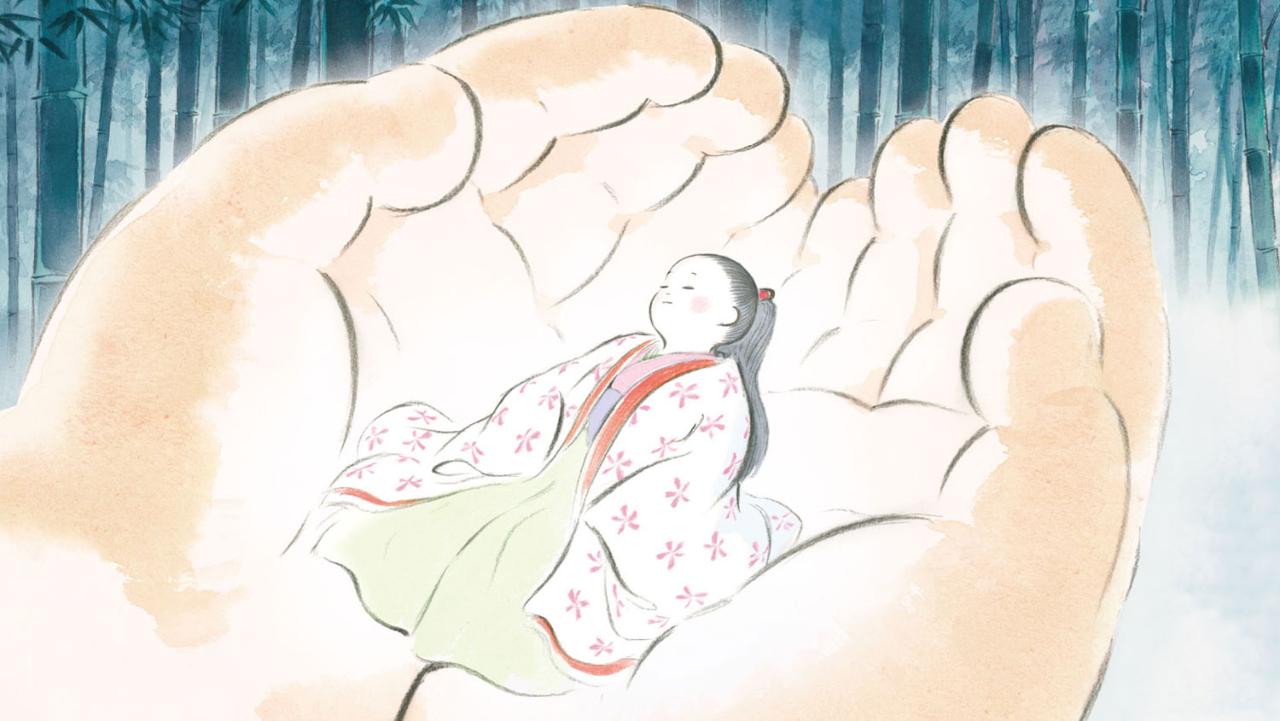
Although how aged these films are would suggest ink wash animation is an experimentation of the past, it lives on into the digital era, albeit perhaps as an uncommon fringe style. The late Ghibli master Isao Takahata’s film The Tale of Princess Kaguya (2013) was done entirely in a sumi-e style, to a beautiful hand-drawn effect. The coloring was done with digital paint, but the fact that it is computer-made does not take from the visuals at all.

Expresii, a drawing program aimed at simulating ink and watercolor with digital software. The results are very high fidelity. Demonstrations of the app in action are as follows:

Rooftop animation, a Hong Kong animation studio lead by SCAD alumnus Angela Wong, had been working on a film using Expresii. Though the project was unfortunately cancelled, a demo teaser can be seen here:

Another completed film by Rooftop animation is Green Earth (2017), created with a combination of traditionally hand-painted and digital ink-wash drawings.

The power of digital programming has in fact facilitated the ease of (re)creating the unique Asian ink wash style. Though it would be wildly unrealistic to say it can compete against both 3D animation and other sharp, comic book-like 2D animation, I hope that it can continue to be used in animation productions, and appreciated by wider audiences as an aesthetic steeped in history and culture.

MP14 | “Ryan” – a documentary by Chris Landreth

In 2001, Chris Landreth interviewed Ryan Larkin, award-winning Canadian animator and at the time of the interviews, a panhandler recovered from drug abuse and reliant on alcohol. Based on multiple recorded interviews, Landreth and his team at Toronto’s Seneca College created the visuals in Ryan, a 14-minute animated documentary that would go on to win Best Animated Short Film at the Oscars.  

It is indeed a brilliant work; Ryan is easily one of the films I found most interesting in this course. The majority of the film is presented in a mirrored reality, where perspective does not seem to be linear and the grotesque characters’ psychological scars are shown externally. The CGI and 3D animation is aptly employed to do this to a viscerally disconcerting yet visually arresting effect.

The most intriguing is Ryan’s model, his body skeletal and his head almost hollowed out. Little arms on his thermos distracting him clue in to his alcoholism, which is the climax of the film when Landreth brings up the subject, and Ryan reacts aggressively, red literally spiking out from his head. It also includes touching moments where Ryan’s face almost begins to reconstitute itself, such as being reunited with one of the frames of his animation and speaking to his previous partner Felicity whom he still regards fondly. The film paints Ryan’s figure as a once-successful and prolific artist, suck in his predicaments, as the film says “living every artist’s worst fear”.

The film references and gives background to Larkin’s two famous works Walking (1969) and Street Musique (1972), both of which were done with Canada’s National Film Board and won many awards and nominations. They are worth viewing for their whimsical mood and style, all painstakingly done traditionally with various media (including watercolor).

Ryan Larkin’s Oscar-nominated short Walking (1969)
Larkin’s film Street Musique (1972), using morphing techniques

References

MP13 | American wartime animation (part 3: information)

Despite — or perhaps because — wartime being a time of tension and uncertainty, the American animation industry consolidated its forces towards the Second World War effort. Animation was used as a medium to portray war, to instruct, and to disseminate messages. This is the third and final part of the series.

In the previous part I looked at wartime animation as propaganda, mainly sending anti-Nazi messages and satirizing Hitler. This section deals with films carrying more specific calls to action, aimed at the home front in the United States during the Second World War.

Informative and educational animations were high in demand, some for the purpose of training troops, and others for civilians at home. The example we saw in class is the black and white Looney Tunes: Point Rationing of Foods (1943). It was commissioned by the Office of War Information, produced in collaboration with UPA, directed by Chuck Jones. It sought to inform Americans on the wartime rationing system. As an informative film, it uses a very graphic, modern style, and, its many use of holds make it somewhat more a graphic reel rather than a fully animated film.

While in the throes of aiding the WWII Allies, the US also had presidential elections, and President Franklin D. Roosevelt was up for re-election. Hell-Bent for Election (1944) was made for his election campaign, sponsored by the United Auto Workers and directed by Chuck Jones. It is UPA’s first major success, displaying its stylish graphic aesthetic and dynamic camera angles.


Victory Through Air Power (1943) was not shown in class, but I had seen it referenced in many histories and biographies of Walt Disney or his eponymous studio. It was based on the book of the same name by Alexander de Seversky, an aviation expert and strategist. A 70 minute feature film, it came about when Disney read de Seversky’s book and felt compelled to disseminate his theories on air bombing strategies, and how this would lead to the Allies’ victory. The film was apparently even shown to and approved of by Roosevelt.

As a bookend I’d like to bring up Brotherhood of Man (1945), directed by Bobe Cannon and John Hubley. In the wake of WWII, which for America was a commercially successful war and saw society more unified than ever to support the war effort, there was continued enthusiasm for societal cooperation in America, much like during the wartime. Previously overlooked sectors of society like women and ethnical minorities, now had unprecedented contribution and standing in the workforce. The short serves as an educational video against racial prejudice in post-War America.

To summarize, this three-part series aimed to look at animation as a vehicle for the American war effort in WWII, as well as a way through which to illustrate society and important historical events in America in relation to the war.  

Sources:

On Happiness Road

In animation history class we discussed animated films from all over the world. We discussed animations coming out of China, Hong Kong, the United States of America, Russia, and many more countries. In this post I will discuss the Taiwanese animated film On Happiness Road. This film was created by Sung Hsin-yin, a young director and screen writer from Taiwan. The film itself is a slice of life story that comments on Taiwanese society, and its changes in the recent years. The South China Morning Post wrote an article about the animation, and in it reported “But as she looked back at her life, Sung recalled the street in Taiwan where she grew up and the intriguing juxtaposition between its name – Happiness Road – and the reality of life in the neighbourhood. Despite its cheery name, at the end of the road was a large, dirty trench, which made headlines in 1997 when kidnappers dumped the body of a Taiwanese actress’ 16-year-old daughter in it.” While the film didn’t score big in the box office (it only made about $430,000) USD, the film itself has left a big impact on Taiwan and Taiwanese animation to come.

https://www.scmp.com/culture/film-tv/article/2148245/happiness-road-taiwanese-animation-tells-cruel-and-dark-story

Kawamoto’s journey of animation

In my last post I discussed Kihachiro Kawamoto who made the stop motion puppet film The Demon (Oni). We last left off in discussing how Kawamoto had travelled to Prague to study under the the artist Jiří Trnka. Kawamoto felt Trnka’s animation was so close to life that it inspired him to continue to further push his own puppet animation. He decided to travel the world after that, going to places like  Poland, Hungary, Bulgaria, Moscow, and Central Asia. And when his world tour journey was over he returned to Japan. It was upon his return that he would animate the stop motion television show Three Kingdoms that would run from the years 1982 to 1984.  It was during this time that he created The Demon (Oni, 1972). Kawamoto died in the year 2010 at the age of 85, leaving behind a legacy of filmmaking and artistry that would inspire future generations.

https://www.nishikata-eiga.com/2010/08/passing-of-puppet-master-kihachiro.html

The man behind the demon, Kawamoto the puppet animator

In class we watch the Japanese stop motion The Demon (Oni) by Kihachiro Kawamoto. After seeing the short film, I instantly fell in love with it and wanted to know more about the artist behind the film. To begin, I will discuss the creator of the film. The Japanese puppet designer Kihachiro Kawamoto first began his art career as a production designer under the artist So Matsuyama, an art director at Toho studio. While he was at the studio, Kawamoto was able to learn about the film making process, which would eventually come into play later in his life. During his four years at the studio he was also able to work alongside the legendary puppet animator Tadahito Mochinaga, Japan’s first puppet animator. Kawamoto left the studio in 1950 and in 1958 he founded his own production company, Shiba Productions. This production company specialized in commercial animation. In 1963, Kawamoto would eventually travel to Prague to study under the puppet animator Jiří Trnka.

              Kihachiro Kawamoto’S story will continue in my next post so stay tuned.

Figure 1 Kawamoto’s self portrait

https://www.nishikata-eiga.com/2010/08/passing-of-puppet-master-kihachiro.html

Amazon’s Undone and its stylistic rotoscoping

Recently, Amazon came out with an animated television show Undone. Not only is the show animated, but it utilizes the rotoscoping technique in order to create a painterly style animation. Looking behind the scenes of the production, you will find that the actors actually act out the whole show in live action, similar to as if they were making a regular live action show. Then the animators take each frame and paint over it, creating a highly stylized render. The stylization suits the show quite well, seeing that the main character has a moral dilemma upon which leaves her stuck in between reality and fantasy. An IndieWire article goes further in depth on the creation of the show, “Amsterdam-based animation studio Submarine assembled a team of artists and painters from all over Europe to bring the animation elements to life, with rotoscope done by the veteran team behind “A Scanner Darkly” at Austin-based Minnow Mountain, led by co-producer Craig Staggs.”

In conclusion, the show is most definitely worth watching due to its highly rated plot and its beautifully done rotoscoping animation.

Tokyo Godfathers

The film Tokyo Godfathers is one of my favorite movies and by far my favorite animated Christmas movie to date! The film is a beautiful story about conincidences, and how in life you can never expect what ties all of us together. Not only does Tokyo Godfathers feature the theme of coincidences, but it also comments on Japan’s increasing homeless population. The film was directed by Satoshi Kon. Kon has also worked on films like Perfect Blue, another film that comments on society’s morals. “’As I am an animation writer/creator, I wanted to send my message to viewers throughout this feature, to make them feel relieved from their troubles, worries, and discontentment from everyday life by using the ‘homeless’ characters who are a socially disadvantaged people that are living their lives vitally and lively with warm and kind hearts.”‘ Who also worked on this film was the notable script-writer Keiko Nobumooto. You may know Nobumoto for his work Cowboy Bepbop.

The film won an Excellence Prize at the 2003 Japan Media Arts Festival, along with the Best Animation Film at the 58th Mainichi Film Awards.

https://www.austinchronicle.com/screens/2004-01-23/193945/

Michael Patterson, rotoscope artist

Previously in my blog post I discussed the making of the Take on Me music video, an important piece of animation rotoscoping history. Patterson is known mostly as an experimental film artist. He graduated from CalArts after creating his Academy Award winning animated short Commuter.  Of course, as I previous explained in my prior blog posts, Patterson’s claim to fame occurred when he animated Take on Me in 1985. According to his 2008 USC page, Michael later on he “teamed up with his wife Candace Reckinger to direct a string of MTV hits that include, Suzanne Vega’s ‘Luka’, Sting’s ‘Be Still My Beating Heart’, Donald Fagen’s ‘Tomorrow’s Girls’, and Paula Abdul’s ‘Opposites Attract’, which won the Grammy Award for Best Music Video in 1990”. In 2017, Patterson was an acting animation director for the popular animation app “FlipaClip”, and can be seen in an interview about the Animate Unravel Contest the app featured. As it can be seen, Michael Patterson’s passion for animation is still thriving today as he experiments more and more the endless possibilities.

https://web.archive.org/web/20080315233057/http://anim.usc.edu/faculty/mike.html