MP2 | Lotte Reiniger – Achmed’s Legacy

The Adventures of Prince Achmed (1926) is considered the earliest surviving animation feature film, and was seminal in both production technique and artistic height.

As mentioned in my last post, Reiniger and her team developed the precursor to the multiplane camera while working on Achmed, which was major for later mainstream animation. But Achmed is also connected to fine art animation through its team: Berthold Bartosch, who worked on special effects and backgrounds for Reiniger’s production, later used similar multi-layered glass methods for his epic tragic short The Idea (1932). Walter Ruttman was also a background artist on Achmed and his later abstract short films using film tinting techniques placed him firmly within the avant-garde filmmaking tradition.

Screencap from Achmed.

The legacy of Reiniger’s silhouette style has also lived on in animation. The most evident and notable example is French Michel Ocelot’s silhouette works; most notably his television series Ciné Si (1989), perhaps better known in its collected form in the compilation film Princes et Princesses (2000), which are exclusively in the style of silhouette animation. These works and Ocelot’s oeuvre deserves its own analysis for another post.
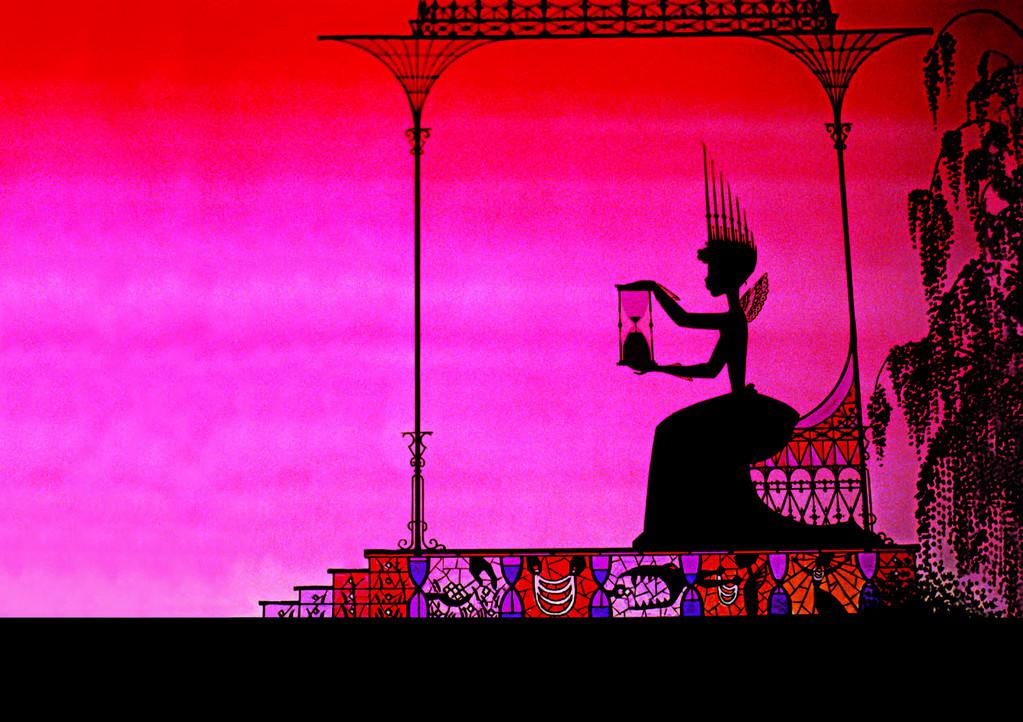
Art from Michel Ocelot’s Princes et Princesses.

The cutout silhouette style has been imitated in cel animation format in the 1997 anime Revolutionary Girl Utena, which was in turn referenced by Cartoon Network show Steven Universe. Steven Universe creator and showrunner Rebecca Sugar has also named Reiniger as the specific inspiration for the episode ‘The Answer’.
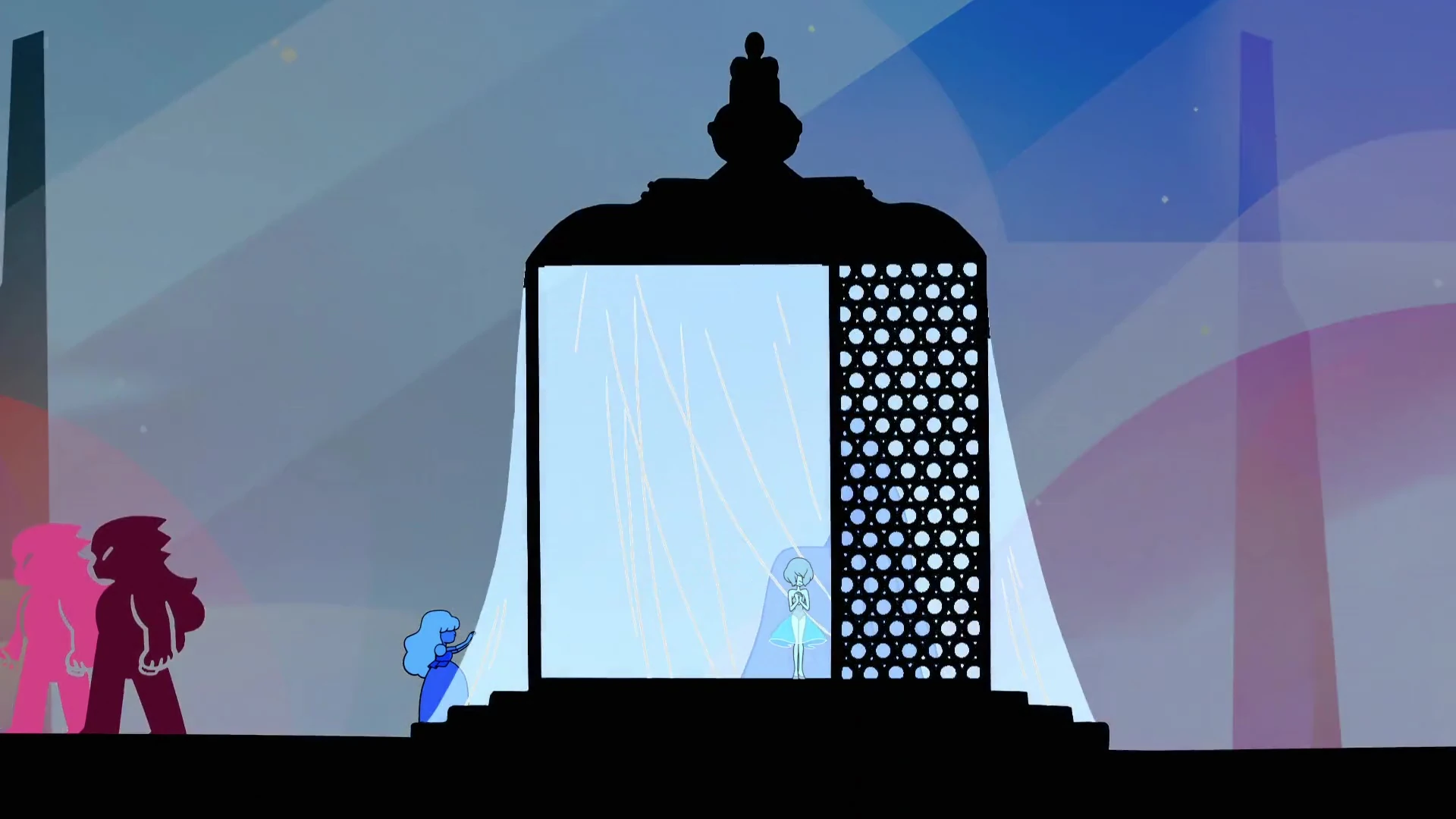
Screencap from Steven Universe episode ‘The Answer’

As if Achmed being the directorial debut of then 26-year-old Reiniger and her husband was not impressive enough, it was a pioneering film in form and technique, and has been paid homage to as such up until the 21st Century. Here is a Gobelins Annecy 2015 short that pays tribute to Reiniger and Koch, and includes a subtle hint at the political adversity they faced in World War II Germany in parallel to their partnership in works of art.

Claudia Lau

Major Post 3: Object Animation and Mystical Visions

I want to applaud everyone in class for their object stop motion animations, they were done very well. They had really unique and different storylines. I didn’t know what to expect, considering this was the first project, and I was genuinely surprised. It was entertaining to watch and hear how each story came to life.

There is a scene in Disney’s Ratatouille (2007), where Remy (the main character) and Emile (Remy’s brother). are imagining what the visual of taste would look like as they savor each thing they eat. I was reminded of this scene when watching the abstracting scenes of Diagonal Symphony (1924) by Viking Eggeling. It was even more apparent in Oskar Fischinger’s animation studies. A lot of his studies reminds me of the old Disney films with the background music, playful and bouncy. The music joining the animations adds a nice touch of unity. Where as watching Radio Dynamics (1942), was awkward but nice to watch.

Major Post 4: Oskar Fischinger and his Wax Machine

Oskar Fischinger was born in Germany in the early 1900s. He was an animator who spent his whole life working to perfectly synchronize sounds and movement in his short animations. Despite his drive to perfectly pair the two medias his only interactions with music were violin lessons while in school and his apprenticeship at building organs.

Fischinger was more than just an animator and music enthusiast he was also an engineer. He used his skills in that field to build a machine that would revolutionize abstract animation, the wax machine. Early models of this machine had pipe-shaped mixtures of colored wax and clay slowly fed into a slicer with a rotating blade. In front of this device would be a camera that was synchronized with each cut of the blade. You can see the wax veins morph and change in the video I have linked below. Despite his invention being used in amazing films like The Adventures of Prince Achmed, Fischinger didn’t see a cent from the venture since his partner, Ruttmann had legally licensed the wax machine for use in films and commercial work. Fischinger’s bad luck only seemed to continue as he moved to the United States and had big companies like Disney and Paramount discredit him and under pay him for his work.

LeAnn Schmitt

https://vimeo.com/54587174

Project 1-WIP 2-Production

Once LeAnn Schmitt and I finished shooting the stopmotion sequence, I started editing it on Adobe Premier Pro 2019. This is where we focused on placing sound effects for the actions show in the stop motion. From the previous post, our concept is about making a peanut butter and jelly sandwhich. Due to the simplicity of the concept itself, we agreed on using a lot of different sound effects but not too much of it.

The sound effects that were used both came from online and done in person. Although, it was quite difficult to do it in person since using a phone microphone captures all of the surrounding audio. I did however try to lessen the noise once I added it onto the video editing program. Finding online sources, was easy if you know how to find them properly. I was able to find a website that sourced free mp3s that had a good search engine. The sounds I used may have come from the literal object, however, I did also use sounds that came from random sources. (ex. mac and cheese). Once it was done, I double checked the video for any mistakes and exported it.

Julia Reymundo and LeAnn Schmitt

Project 1 – Object Animation WIP by Janelle and Tan

After seeing the assignment, it immediately brought memories back from my younger self. Talking about object movement, it was my all-time favourite thing to play with. I loved playing with toys, role-playing each characters and creating stories. During class before, I used to love playing with my stationary on the classroom desk. Every movement that I did to the pens, rubber, ruler and stapler are scenes of a story in my head, it is like watching a tiny movie with myself.

Therefore, I suggested a very short story with stationary so we did it. The story we chose is simply a knight slayed a monster. Here is our “actors”.

Random stationary + random objects we have

Characters:
USB and a Lipstick : Victims
Rubber : A Knight
Pegasus Toy : Royal ride of the Knight
Scissors : A Sword of the Knight
Random Stationary and An Apple Charge Wire : The Evil Monster

We first decided to use the scissors as the head of the monster because it looks dangerous, fitting the theme of a monster but after a few discussion, we decided to use the scissors as the sword of the knight and replaced the head with a stapler because the scissors actually have a cover which is similar to a sword, as for the stapler, it is much more easier to work with.

Originally, we only decided on the knight slaying a monster as the story. We wanted to add a clear opening and ending so we added victims, a quick reason for the knight to slay the monster and the monster is dead in the end.

We had a trouble of shooting this because I forgot to bring a phone holder for the assignment so we spent a little bit of time to find a way to hold the phone. We went to an empty room to shoot this and hold the phone with the two tables.

The finale when we are done shooting

One of the frame

One of the frame

Thang Tsz Ching, Janelle
Jiawan Tan

Project 1 – WIP Post 1 – Post- Production

During this project, Victoria and I were able to understand and use the basic techniques for stop motion animation. We were able to understand the differences between the several different ways of animating a character, as we were more familiar with how to create 3D and 2D animation. But this project presented us with the opportunity to learn about and experiment with form of animation that we were not as familiar with.

Victoria’s concept for Doll Face was simple enough to implement at a small scale, while still being creative and translated onto the screen effectively. Although we ran into problems such as how much the doll should be moved between each frame, or how to even physically shoot the scene, I think were able to successfully explore how stop-motion animation is created.

Victoria Courchesne
Eunhae Mary Park

South park; cut out style, computer animated.

Major Post 2

Written by Victoria Courchesne

If you’re a fan of south park, you are familiar with the show’s construction-paper 2D style. While the show now is made using After Effects and 2D scans of the characters, the original pilot for the show was created using traditional cut out animation. The 22-minute-long animation featured multiple shot changes and extensive dialogue. In an interview with The Wired, co-creator of the show Mike Stone referred to the creation of the pilot as hell on earth, and so they came to the conclusion that they needed a better way of creating the show. The documentary film “The Making of South Park: 6 Days to Air” features the shows new production schedule from writing to animation. With a production schedule as crazy as that, the show’s utilization of the modern day animation programs is ideal for the fast-pace turn around. Even on their 23rd season, the shows original creators still remain leading the team, keeping the continuity of the show’s original hand-made style in every episode.

https://archive.org/details/southparkpilot

Sources:

https://www.wired.com/1997/09/it-aint-easy-making-south-park-cheesy/

https://www.cartoonbrew.com/ideas-commentary/6-days-to-air-reveals-south-parks-insane-production-schedule-67657.html

Laika, Kubo, Vinton- Icons of Stop motion and Claymation

-Major post 1

written by Victoria Courchesne

After completing the first project for our course, you might be curious about stop motion as an animation medium. What we know as Claymation today closely corresponds with the stop motion animation style of the 1900’s. One of Claymation’s most talented animators was a man named Will Vinton. In the 1970’s Vinton created his own animation studio he named after himself, Will Vinton Studios, in Portland Oregon. One of the studios most famous animations was the commercial they did for the Caifornia Raisins. The studio later became Laika studios, which has been nominated for four Oscars. The purpose of mentioning Laika is because they are my favorite Stop motion studio. Kubo and the two strings is a masterpiece of story, color, and music that has won the adoration of millions around the world. Even though the film was “ Stop motion”, the film used 3D modeling programs to create many of their assets, including Kubo’s face and the Giant Skeleton. It is interesting to compare the California Raisin ad’s Claymation style to the stop motion style the studio later adopted.

Sources:

https://area.autodesk.com/life-in-3d/5-fast-facts-on-kubo-and-the-two-strings-by-laika/

https://www.cartoonbrew.com/tag/will-vinton-studios

Some of the parts for Kubo’s face were modeled in Autodesk Inventor because of their size.

MP1 | Inventions from both sides of the Atlantic

In the first two weeks of class we covered the early years, from animation toys, to the creation of full films with sound and the pioneering of many important animation processes. It’s a lot, though we haven’t even looked at anything Disney yet.

What it made me realize was that animation history was less of a line than a zig-zag: the back and forth process of invention and industrialization, as well as the cross-pollination of animation techniques between Europe and America. All were important factors in the development of the animation as an art form and as an industry.

The two sides of the Atlantic circa 1900 (source)

Early inventions in what we now think of as animation mostly came from Europe. Frenchman Émile Reynaud created the first film projection animations or Théätre Optique in 1888, expanding from earlier toys such as the phenakistocope and zoetrope, attributed to Joseph Plateau (Belgium) and William G. Horner (UK) respectively. As early as the zoetrope however, Americans tapped into industry and manufacturing; American William Ensign Lincoln licensed his version of the zoetrope to the board game company Milton Bradley and Co. in 1865-66.

Of course what interests us is the techniques that have become standard. John Randolph Bray (US) and Raoul Barré (Canada/US) were important in creating both technical processes, such as celluloid [cels] and the hole and peg system, and production processes, i.e. the industrial animation pipeline; all three are still in use in some form or another today, speaking to how influential their inventions were. Interestingly, Barré, with Bill Nolan, was also the first to make animated adverts, and created the first 100% animation focused studio.

Different peg bar systems, from article on the history of the peg bar

The first character driven animation, or perhaps ‘animated cartoon’, was Emile Cohl’s (France/US) Fantoche the Clown in 1908; American cartoons included Krazy Kat (1916), Felix the Cat (Pat Sullivan and Otto Messmer 1919), and Fleischer studios’ iconic characters (1920s-30s). And of course later on we’ll meet Mickey Mouse, most iconic of all animated cartoons.

American Winsor McCay is an interesting case; the naturalistic draftsmanship he used from his illustration background elevated animation to a new level. He also pioneered technical animation methods such as inbetweening and cycles/loops as shown in Gertie the Dinosaur (1913), for which John Randolph Bray tried to sue him after patenting those methods. Gertie also carries the legacy of animation as performance and showmanship like with early pioneers Georges Méliès (France) and James Stuart Blackton (US).

A frame from Gertie the Dinosaur – notice the ‘stop here’ instruction, presumably for the assistant (source)

Animation was exclusively in short film form, until the first European feature-length animation films. They include El Apostol (1917) and Peludopolis (1930) by Italian-Argentinian Quirino Cristiani, the second of which was the first with sound, and The Adventures of Prince Achmed (1926) by German Lotte Reiniger and her team. Achmed in particular seems important to me, as its use of the multiplane glass technique allowed for many-layered backgrounds that further pushed animation towards a truly cinematic look, and was an early version of the multiplane camera, which was used in Disney’s first feature, Snow White and the Seven Dwarfs (1937), and allowed it great compositional depth.

We always think of Disney when we think of animation history. In a way, Disney’s Golden Age is kind of an ‘Italian Renaissance’ of animation, because it married both industrial efficiency and artistic height. But without seeing the historical context before and at the time of Disney’s birth, we could easily forget the early origins and all the other milestones that allowed Disney to flourish.

Claudia Lau

Project 01: Object Animation- WIP

Sydney and I did not take too much time brainstorming and came up with a cute idea. We had limited resources for subjects so we tried to get creative since we were open to use anything! Our two subjects: a teddy bear and grapes.

We filmed in my room and used the desk in the living room as the setting.

Our main struggle was trying to keep the camera steady since we did not have a tripod. Some areas were not as smooth so we went back and had to film some scenes again. We have a lot of strong clear actions so hopefully the audience can tell what it happening from us using inanimate objects for subjects! We also used a hair clip to help position the limp teddy bear.


Chandi Marsh

Sydney McPherson