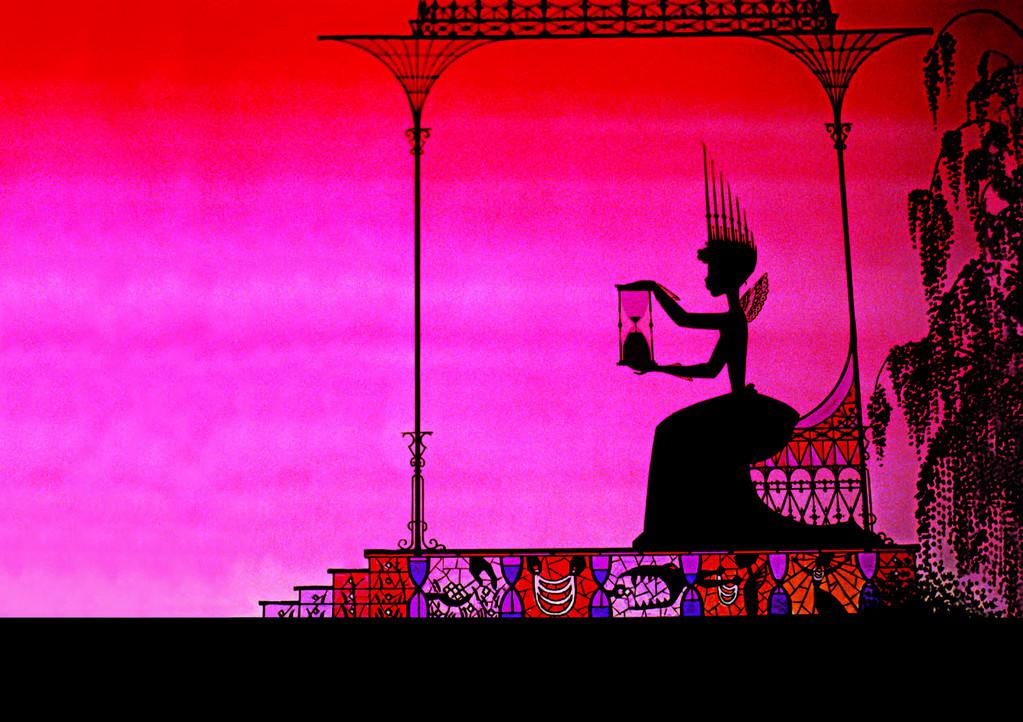
MP4 | Bartosch’s “The Idea” – an adaptation

Bartosch’s 1932 film The Idea was based on a book of woodcuts, or a ‘wordless novel’, by Belgian artist Frans Masereel. It was initially conceived in 1930 to be a collaboration between the two artists, but Masereel soon left the project after realizing how tedious animation was.

Perhaps the original author’s departure was key in shaping the final film as we see it today; William Moritz’s article points out the narrative and tonal differences between the original woodcuts and Bartosch’s adaptation. Although war era socialist-pacifism united Masereel and Bartosch, their distinctness from each other is clear. Masereel came from the practice of political satirical woodcuts, while Bartosch was a filmmaker-animator who had worked for Lotte Reiniger on Prince Achmed, which I’ve discussed in previous posts.

The Idea’s conception in the novel, springing forward from the Thinker’s mind.
The Idea’s conception in the film, who appears before the contemplative Thinker seemingly from the starry cosmos.

Firstly the intrinsic difference between a static image format and a video one, meant Bartosch had to significantly shorten the story from Masereel’s 70-plus page epic novel; Bartosch only chooses select woodcuts to be animated into real time. In the original novel where the protagonist The Idea goes through many more hardships, and eventually returns to her creator, only to find that she has been replaced by a new Idea in the form of a blonde woman, which is subsequently sent out to the world, and the original Idea is crucified. Changes of scenario that Bartosch made turned the story of The Idea not one of sardonic tragedy, as in the original, but a tragic drama that still remains noble and hopeful, finally letting The Idea return to the starry cosmos that she had originally appeared from. Another important part of the film, is the role Arthur Honneger’s music, played on an early electronic instrument, which repeats certain leitmotifs for the Idea throughout the film, and maintains the dignity of the Idea as she goes through her tribulations. The multiplane glass method that Bartosch designed for Reiniger, and his use of soap to create soft haloes of light, contribute significantly to The Idea’s atmospheric look, as well as the overall visual motif of light, which was not present in Masereel’s original novel. Though the thick outlines and use of highly contrasting light and dark no doubt evoke Masereel’s woodcut quality, the overall resulting imagery is vastly different.

Though the starting point of The Idea was Masereel’s work, the film took flight and became distinctly Bartosch’s — in form, visual style, theme and message. It is a shame that many Bartosch’s other works are lost; otherwise we would have a better picture of Bartosch’s entire oeuvre, and be able to better understand his artistry.

‘Bartosch’s The Idea‘ by William Moritz, in A Reader in Animation Studies, ed. Jayne Pilling
‘Frans Masereel’, GraphicWitness – visual arts & social commentary, https://www.graphicwitness.org/historic/masereel.htm#dieidee


Claudia Lau

Major Post 2: Winsor McCay

Winsor McCay; a man of detail and precise craftsmanship, with reminiscences of stylistic art nouveau. 🙂
By chance, during my journey to the massive library in Causeway Bay (HK Central Library), I saw, sitting in the specially book stand…
“Little Nemo in the Palace of Ice and Further Adventure and Further Adventure”

Much to my joy, I could say I know the name because of ANIM223!
In this comic, the plot is based on the DREAMS of Little Nemo, where he explores different worlds and stumbles into problems with the Princess of Slumberland.

To my surprise, it seemed like the comic caught Japan’s interest and Film Director, Masami Hata, collaborated with America’s William Hurtz to transform the comic into an American-Japanese animation in 1989.
(Side note: Masami Hata also directed one of the episodes in “JoJo’s Bizarre Adventure” in 2016!)

We’re jumping further ahead here in the timeline of animation, however this is such a good opportunity to see how American Cartoonists/Animators influenced worldwide – to Japan, another country known for their iconic animations, and vice versa.
However, despite having many talented creatives involved in creating “Little Nemo”, many came and left, leaving the project unstable. To further complicate it, there were language barriers as well. Bet they learnt a lot and overcame many different obstacles as some still carried on and persevered.

Another side note: Before Little Nemo, Masami Hata also directed “Ringing Bell” (1978) and “The Sea Prince and the Fire Child” (1981), both of which were accomplished in their own right.
This is def a personal note, because it’s super cute, with magical yet ‘dour’ tones, and has Little Mermaid (1989) vibes, or rather, Little Mermaid has Sea Prince and the Fire Child vibes.

Sammy Liu

Major Post 5: Disney and Rotoscoping/Live Action Reference

Major Post 5: Disney and Rotoscoping/Live Action Reference

             Walt Disney did more than just animate, he worked to make his audience believe that they were part of the worlds he would create. To achieve this immersion Disney Studios used live action reference and rotoscoping to inspire and create many of their most memorable scenes and characters. Linked below is a shot of early live action footage of Kathryn Beaumont, the voice of Alice from Disney’s Alice in Wonderland, which was referenced and rotoscoped by animators.

             Rotoscoping is when an animator will draw over live-action footage of an actor for an animated film. This technique was created by Max Fleischer, the creator of the Out Of the Ink Well series. Originally, it was referenced to as the Fleischer Process when it was first implemented into animation. Rotoscoping can be a good way to make a character feel much more realistic since you are able to capture fine details and emotional shifts that can be hard to see when you are merely looking at references. However, sometimes rotoscoping can have an uncanny and creepy feel to it since it can walk the line between realistic and over exaggerated.  

LeAnn Schmitt

MP2.5 | Miscellaneous Achmed-related thoughts

Because I had a lot of left over material from research for my last post on Adventures of Prince Achmed (1926) and can’t stop stressing how great and important Lotte Reiniger is. Being the first feature animation is sure to make Achmed become a source for many of its successors.

By deduction I imagine it was a very early film produced in the Western world using ‘Arabia’ or Orientalism as its only visual and narrative theme. It was adapted from two stories of the ‘Middle Eastern’ fairytale collection Arabic One Thousand and One Nights, one of which is the now very familiar story of Aladdin and the Magic Lamp, made popular by its circulation in book form and by Disney’s adaptation in 1992. There is actually a ‘Prince Achmed’ in at the very beginning of the film, and I’d like to think the name is a reference to Reiniger’s Achmed, even if it isn’t confirmed.

This Achmed is definitely not Aladdin’s friend.

The harem is a common Orientalist theme, and I think we were all not expecting that scene with Achmed and the servant/entertainer girls entertaining each other in a room. It is worth mentioning that European countries never had an equivalent of the systematic Hays Code that banned ‘immoral’ content. But it seems that Reiniger just has a penchant for racy or sexual more-than-undertones, as also seen from her later short film Papageno (1935). In the handout interview Reiniger admits as much when asked directly about that Achmed scene. What a lady.

Horniness aside, this is a very cool adaptation of Papageno’s story from Mozart’s The Magic Flute; in the original opera the character Papageno is more a sidekick than a main character.

Though I have not surveyed a list of the earliest films (including live action), Achmed might be the earliest feature with a wizard or magic duel sequence, and is most definitely the earliest example of a duel that shows the characters shapeshifting. According to the TVTropes page on ‘Shapeshifter Showdowns’ as it is titled, this is a theme that has existed in human myths and folklore even before the printing press was invented. I was reminded of the Disney film Sword in the Stone (1963) which also involves a witch and a wizard/sorcerer throwing down in magical animal transformer style. Something about turning into different creatures, especially because of our associations with certain animals being good/evil or more or less powerful than other animals, is very entertaining to watch. At least it was the case for child-me, who still re-emerges when to relive watching this sequence.

A duel for the ages (of animation).

It’s noteworthy that the animation technique for changing between animals in Achmed makes more use of morphing, perhaps because of the limitations that come with cutout/silhouette. In Sword in the Stone, and also in another Disney example of a shapeshifting sequence, The Emperor’s New Groove, there is more use of special effects like sparks and jump cuts to show a character has changed animal. Arguably it makes for more interesting pacing and varied rhythm, and as we saw in today’s class (Class 6), synchrony with music was established early on as a Disney trademark method. In the promised future post on Michel Ocelot, I could talk about how this lively rhythm/music accompaniment was brought back to silhouette morphing in Princes et Princesses, but it will be for another day.

Claudia Lau

MP2 | Lotte Reiniger – Achmed’s Legacy

The Adventures of Prince Achmed (1926) is considered the earliest surviving animation feature film, and was seminal in both production technique and artistic height.

As mentioned in my last post, Reiniger and her team developed the precursor to the multiplane camera while working on Achmed, which was major for later mainstream animation. But Achmed is also connected to fine art animation through its team: Berthold Bartosch, who worked on special effects and backgrounds for Reiniger’s production, later used similar multi-layered glass methods for his epic tragic short The Idea (1932). Walter Ruttman was also a background artist on Achmed and his later abstract short films using film tinting techniques placed him firmly within the avant-garde filmmaking tradition.

Screencap from Achmed.

The legacy of Reiniger’s silhouette style has also lived on in animation. The most evident and notable example is French Michel Ocelot’s silhouette works; most notably his television series Ciné Si (1989), perhaps better known in its collected form in the compilation film Princes et Princesses (2000), which are exclusively in the style of silhouette animation. These works and Ocelot’s oeuvre deserves its own analysis for another post.

Art from Michel Ocelot’s Princes et Princesses.

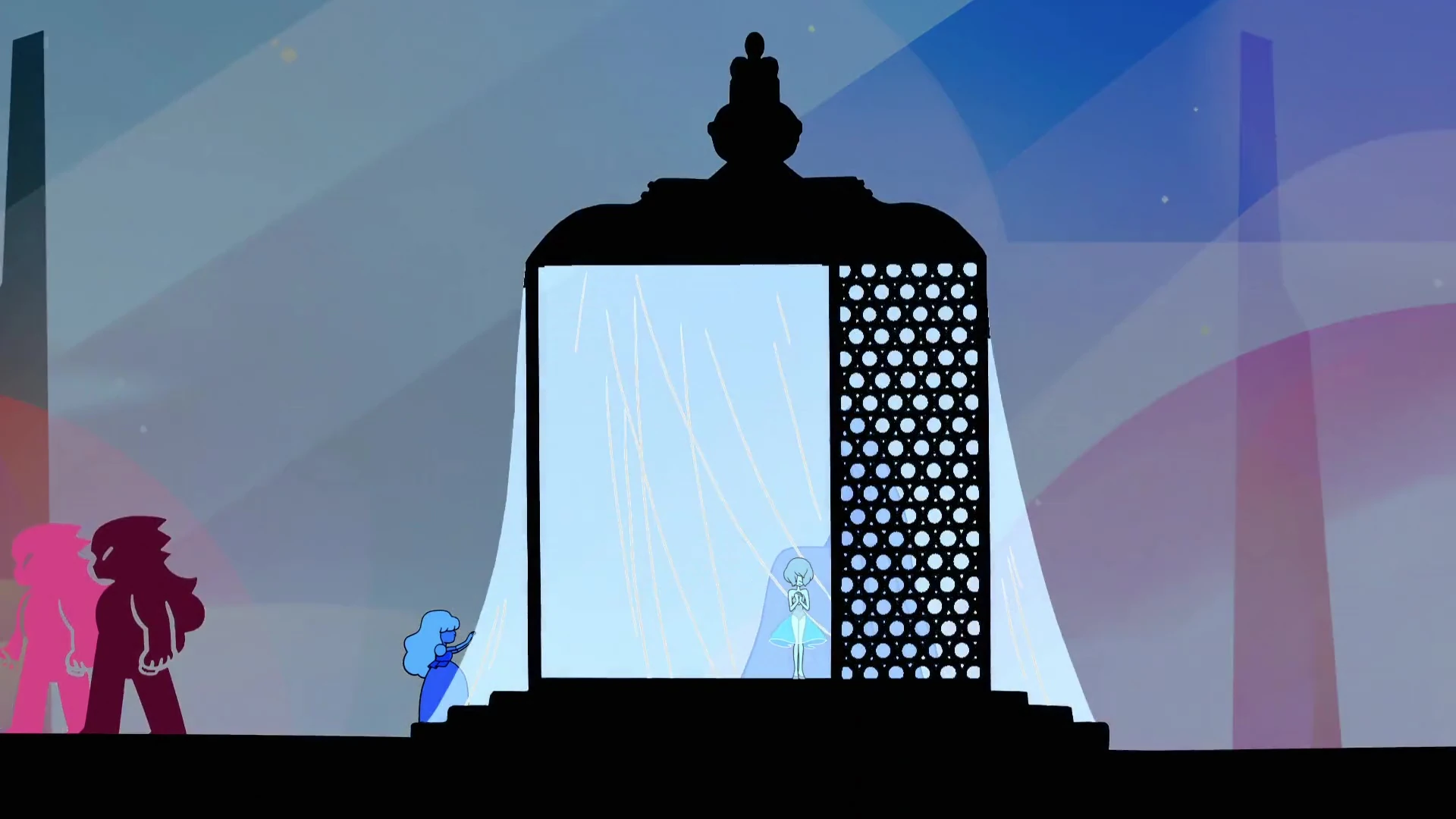
The cutout silhouette style has been imitated in cel animation format in the 1997 anime Revolutionary Girl Utena, which was in turn referenced by Cartoon Network show Steven Universe. Steven Universe creator and showrunner Rebecca Sugar has also named Reiniger as the specific inspiration for the episode ‘The Answer’.

Screencap from Steven Universe episode ‘The Answer’

As if Achmed being the directorial debut of then 26-year-old Reiniger and her husband was not impressive enough, it was a pioneering film in form and technique, and has been paid homage to as such up until the 21st Century. Here is a Gobelins Annecy 2015 short that pays tribute to Reiniger and Koch, and includes a subtle hint at the political adversity they faced in World War II Germany in parallel to their partnership in works of art.

Claudia Lau

Major Post 4: Oskar Fischinger and his Wax Machine

Oskar Fischinger was born in Germany in the early 1900s. He was an animator who spent his whole life working to perfectly synchronize sounds and movement in his short animations. Despite his drive to perfectly pair the two medias his only interactions with music were violin lessons while in school and his apprenticeship at building organs.

Fischinger was more than just an animator and music enthusiast he was also an engineer. He used his skills in that field to build a machine that would revolutionize abstract animation, the wax machine. Early models of this machine had pipe-shaped mixtures of colored wax and clay slowly fed into a slicer with a rotating blade. In front of this device would be a camera that was synchronized with each cut of the blade. You can see the wax veins morph and change in the video I have linked below. Despite his invention being used in amazing films like The Adventures of Prince Achmed, Fischinger didn’t see a cent from the venture since his partner, Ruttmann had legally licensed the wax machine for use in films and commercial work. Fischinger’s bad luck only seemed to continue as he moved to the United States and had big companies like Disney and Paramount discredit him and under pay him for his work.

LeAnn Schmitt

https://vimeo.com/54587174

MP1 | Inventions from both sides of the Atlantic

In the first two weeks of class we covered the early years, from animation toys, to the creation of full films with sound and the pioneering of many important animation processes. It’s a lot, though we haven’t even looked at anything Disney yet.

What it made me realize was that animation history was less of a line than a zig-zag: the back and forth process of invention and industrialization, as well as the cross-pollination of animation techniques between Europe and America. All were important factors in the development of the animation as an art form and as an industry.

The two sides of the Atlantic circa 1900 (source)

Early inventions in what we now think of as animation mostly came from Europe. Frenchman Émile Reynaud created the first film projection animations or Théätre Optique in 1888, expanding from earlier toys such as the phenakistocope and zoetrope, attributed to Joseph Plateau (Belgium) and William G. Horner (UK) respectively. As early as the zoetrope however, Americans tapped into industry and manufacturing; American William Ensign Lincoln licensed his version of the zoetrope to the board game company Milton Bradley and Co. in 1865-66.

Of course what interests us is the techniques that have become standard. John Randolph Bray (US) and Raoul Barré (Canada/US) were important in creating both technical processes, such as celluloid [cels] and the hole and peg system, and production processes, i.e. the industrial animation pipeline; all three are still in use in some form or another today, speaking to how influential their inventions were. Interestingly, Barré, with Bill Nolan, was also the first to make animated adverts, and created the first 100% animation focused studio.

Different peg bar systems, from article on the history of the peg bar

The first character driven animation, or perhaps ‘animated cartoon’, was Emile Cohl’s (France/US) Fantoche the Clown in 1908; American cartoons included Krazy Kat (1916), Felix the Cat (Pat Sullivan and Otto Messmer 1919), and Fleischer studios’ iconic characters (1920s-30s). And of course later on we’ll meet Mickey Mouse, most iconic of all animated cartoons.

American Winsor McCay is an interesting case; the naturalistic draftsmanship he used from his illustration background elevated animation to a new level. He also pioneered technical animation methods such as inbetweening and cycles/loops as shown in Gertie the Dinosaur (1913), for which John Randolph Bray tried to sue him after patenting those methods. Gertie also carries the legacy of animation as performance and showmanship like with early pioneers Georges Méliès (France) and James Stuart Blackton (US).

A frame from Gertie the Dinosaur – notice the ‘stop here’ instruction, presumably for the assistant (source)

Animation was exclusively in short film form, until the first European feature-length animation films. They include El Apostol (1917) and Peludopolis (1930) by Italian-Argentinian Quirino Cristiani, the second of which was the first with sound, and The Adventures of Prince Achmed (1926) by German Lotte Reiniger and her team. Achmed in particular seems important to me, as its use of the multiplane glass technique allowed for many-layered backgrounds that further pushed animation towards a truly cinematic look, and was an early version of the multiplane camera, which was used in Disney’s first feature, Snow White and the Seven Dwarfs (1937), and allowed it great compositional depth.

We always think of Disney when we think of animation history. In a way, Disney’s Golden Age is kind of an ‘Italian Renaissance’ of animation, because it married both industrial efficiency and artistic height. But without seeing the historical context before and at the time of Disney’s birth, we could easily forget the early origins and all the other milestones that allowed Disney to flourish.

Claudia Lau

Major Post 1 – David O’Reilly

On the first day of class, one of the animations that caught my interest were the works of David O’Reilly. He creates really interesting concepts for his animations. Particularly, “Please Say Something” was visually compelling and had little easter eggs or hints that add to the storytelling. The art style had reminded me of something that I’ve seen before. He uses a low poly style that I can really appreciate and could vibe with. The low poly style is one of my favorites in 3D.

However, the works presented in class weren’t my first exposure to his works. My first experience with his work was when he worked on an episode for the Cartoon Network show, “Adventure Time.” He wrote, directed and animated the episode “A Glitch is a Glitch.” It has the same animation style and his iconic glitch effects. The concept, while still being very ‘David O’Reilly’, for this episode really fits the world of Adventure Time.

Here is a scene in the episode:

Julia Reymundo

Major post 1: Genesis of anim.

Before these history of animation lessons, I barely knew anything about its origin as it never caught my immediate interest. The most I knew would be from watching Tarzan; who had a scene of the Praxinoscope by Reynaud, and seeing glimpses of Disney’s old Mickey Mouse. Therefore, I’m entirely grateful and consciously appreciative of being able to watch animation from the very beginning, even if the early animations are very slow and unappealing – I feel very privileged to learn about its roots and grateful to the people who took the time to innovate techniques and systems, such as the optical theatre, peg system, slash system and the cel-animation technique that enabled us to be where we are today.

In terms of genre, seeing how most of the early animations were generally very quirky yet dark, showed a glimpse of the mindset of that time. I thought it is very amazing how a short clip can carry so many other aspects, such as culture, mannerisms and lifestyle.

It is also very interesting how a lot of the ‘business men’ created shorts with the theme of ‘work’, for example in the “Felix the cat” shorts. They lead the idea of how art and entertainment can come together to make money – which opened even more opportunities for creatives to make a living in the future.

Sammy Liu

Major Post 3: Reiniger

             When we think of famous animators I bet we all jump talented and influential names like Don Bluth, Walk Disney, Glen Kean, James Baxter, and of course Richard Williams. But I doubt you can name as many female animators. I always knew there were women working in the animation industry way back in the 20s but I never saw them doing more than just coloring cells or painting backgrounds. So, when the Professor mentioned a female animator who wasn’t just a names-less colorist but a creator with full artistic responsibility over an animation I perked up.

             This woman was none other than Lotte Reiniger. A German woman who fled Nazi Germany for the safety of England in the 1935. She was an artist fully influenced by pre-WWII Berlin Germany. She was credited for making and contributing over sixty films in her life time but she was best known for her pioneering silhouette animations. Examples of her work are found in films like The Adventures of Prince Achmed and The Beautiful Princess of China and The Lost Shadow. Although, her works were awe-inspiring and critically acclaimed by audiences she had difficulty getting funding for her projects through most of her career. So, in order to fund her projects she worked for Julius Pinschewer, an early producer of advertising. It is said that two of the four ads she created for them have survived to this day (one of which I included a link to below).

             In the end, learning about Reiniger and all the hard work she put into her craft was inspiring and made me wonder how many other unknown female pioneers of animation are there out there.

LeAnn Schmitt